
Predict. Move. Explain. Check.
Choose an operation below. Predict a reasonable answer, explain the value changes, and check the result. Keep the input numbers visible on paper while using the frame as a result accumulator.
Optional read-aloud uses your browser’s voice.
These examples explain the approved mathematical procedure. The physical frame must provide the required rods and sign areas.
1 · Addition: 7 + 5
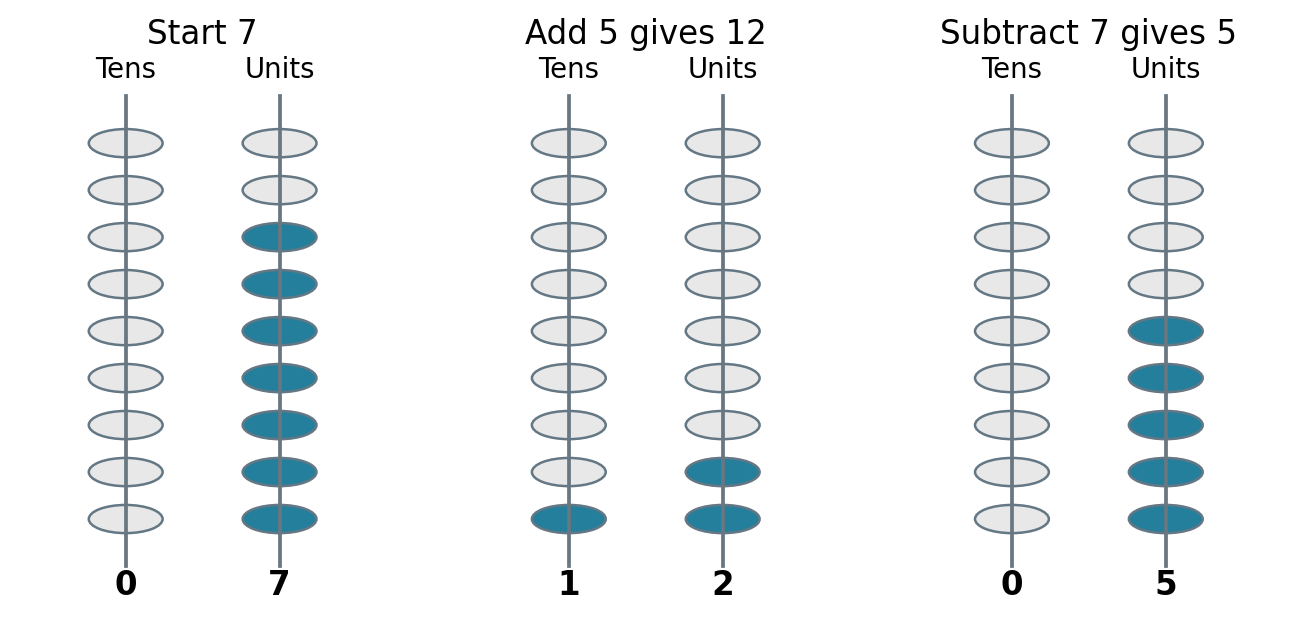
What answer do you expect? Why can a nine-bead rod not temporarily hold twelve units?
Use 5 = 10 − 5. Starting from 7, add one ten and remove five units: 7 + 10 − 5 = 12. The exchange preserves the value.
| Step | Value |
|---|---|
| Start | 7 |
| Add one ten | 17 |
| Remove five units | 12 |
| Check | 12 − 5 = 7 |
Why does adding ten and removing five have the same effect as adding five?
2 · Addition across places: 6.36 + 4.75
| Place | Calculation | Record |
|---|---|---|
| Hundredths | 6 + 5 = 11 | 1 hundredth; carry 1 tenth |
| Tenths | 3 + 7 + 1 = 11 | 1 tenth; carry 1 unit |
| Units | 6 + 4 + 1 = 11 | 1 unit; carry 1 ten |
| Tens | 0 + 0 + 1 = 1 | 1 ten |
Result: 11.11. Check: 11.11 − 4.75 = 6.36.
Why does a carry from hundredths become one tenth, rather than one unit?
3 · Subtraction: 12 − 7
Two unit beads are not enough to remove seven. Use the complement: remove one ten, then add 10 − 7 = 3 units. The display changes 12 → 2 → 5.
The frame does not need to display twelve units on one rod. Check: 5 + 7 = 12.
Why are three units added during this subtraction?
4 · Exchange across zero places: 206 − 9
| Step | Display |
|---|---|
| Start | 206 |
| Remove one hundred | 106 |
| Record nine tens from the exchange | 196 |
| Add 10 − 9 = 1 unit | 197 |
The intermediate 196 is part of the procedure, not the completed answer. Check: 197 + 9 = 206.
5 · Crossing zero: 4 − 7
Remove four positive units to reach zero. Three further units remain to subtract. Represent three negative units and read −3.
For −3 + 5, three positive units cancel the three negative units. Two positive units remain: +2.
| Situation | Rule |
|---|---|
| Add same signs | Add magnitudes; keep the sign |
| Add opposite signs | Subtract smaller magnitude from larger; keep larger magnitude’s sign |
| Subtract a signed number | Add its opposite |
| Multiply or divide signed numbers | Like signs give positive; unlike signs give negative |
A zero result is neither positive nor negative. Crossing zero is a conceptual procedure; do not assume a continuous physical motion unless the mechanism supports it.
6 · Multiplication: 25 × 5
| Partial product | Value |
|---|---|
| 5 units × 5 | 25 |
| 2 tens × 5 | 100 |
| Total | 125 |
The digit 2 represents twenty, so its contribution is 20 × 5 = 100. Check: 125 ÷ 5 = 25.
7 · Multiplication: 359 × 76
| Contribution | Value |
|---|---|
| 359 × 6 | 2154 |
| 359 × 70 | 25130 |
| Total | 27284 |
Multiplication distributes over addition: 359 × (70 + 6). Estimate: 360 × 76 = 27,360, close to the result.
Why does the second round begin one place farther left? Explain using seventy.
8 · Decimal multiplication: 16.86 × 5.34
| Multiplier part | Partial product |
|---|---|
| 0.04 | 0.6744 |
| 0.3 | 5.0580 |
| 5 | 84.3000 |
| Total | 90.0324 |
Prepare rods down to ten thousandths. Check by scaling: (1686 × 534) ÷ 10000 = 90.0324.
Multiplying two tenths gives a hundredth because (1/10) × (1/10) = 1/100.
9 · Division with a remainder: 3257 ÷ 6
Keep the remaining dividend and quotient in separate records. If using the normally negative area as an unsigned quotient record, label it QUOTIENT WORK AREA. If the mechanism cannot maintain both records, write the quotient on paper.
| Quotient contribution | Remove | Remaining |
|---|---|---|
| 500 | 3000 | 257 |
| 40 | 240 | 17 |
| 2 | 12 | 5 |
Answer: 542 remainder 5. Check: 6 × 542 + 5 = 3257. The remainder is nonnegative and smaller than the positive divisor. Restore normal sign labels after the activity.
10 · Decimal division: 36.97 ÷ 5
| Quotient contribution | Remove | Remaining |
|---|---|---|
| 7 units | 35 | 1.97 |
| 3 tenths | 1.5 | 0.47 |
| 9 hundredths | 0.45 | 0.02 |
| 4 thousandths | 0.02 | 0 |
Answer: 7.394. Check: 7.394 × 5 = 36.970. A thousandths rod is needed.
For a decimal divisor, scale both numbers equally: 3.6 ÷ 0.5 = 36 ÷ 5 = 7.2. Some divisions recur indefinitely; label rounded or truncated results.
What is 7 + 5?
Choose an answer when you are ready.
Can you explain an exchange without referring only to bead movements? How does your check support the result?