
Chapter 4 · Operations on numbers
What happens when we calculate?
Addition, subtraction, multiplication and division describe relationships between quantities. Understanding those relationships helps us check our answers.
Optional read-aloud uses your browser’s voice.
Question
If 7 + 5 = 12, how can you check it without repeating the addition?
| Operation | Relationship | Example |
|---|---|---|
| Addition | Combine or increase quantities | 7 + 5 = 12 |
| Subtraction | Find a difference or remove a quantity | 12 − 7 = 5 |
| Multiplication | Scale a quantity; whole-number examples can use equal groups | 5 × 3 = 15 |
| Division | Find equal shares or count equal groups | 15 ÷ 3 = 5 |
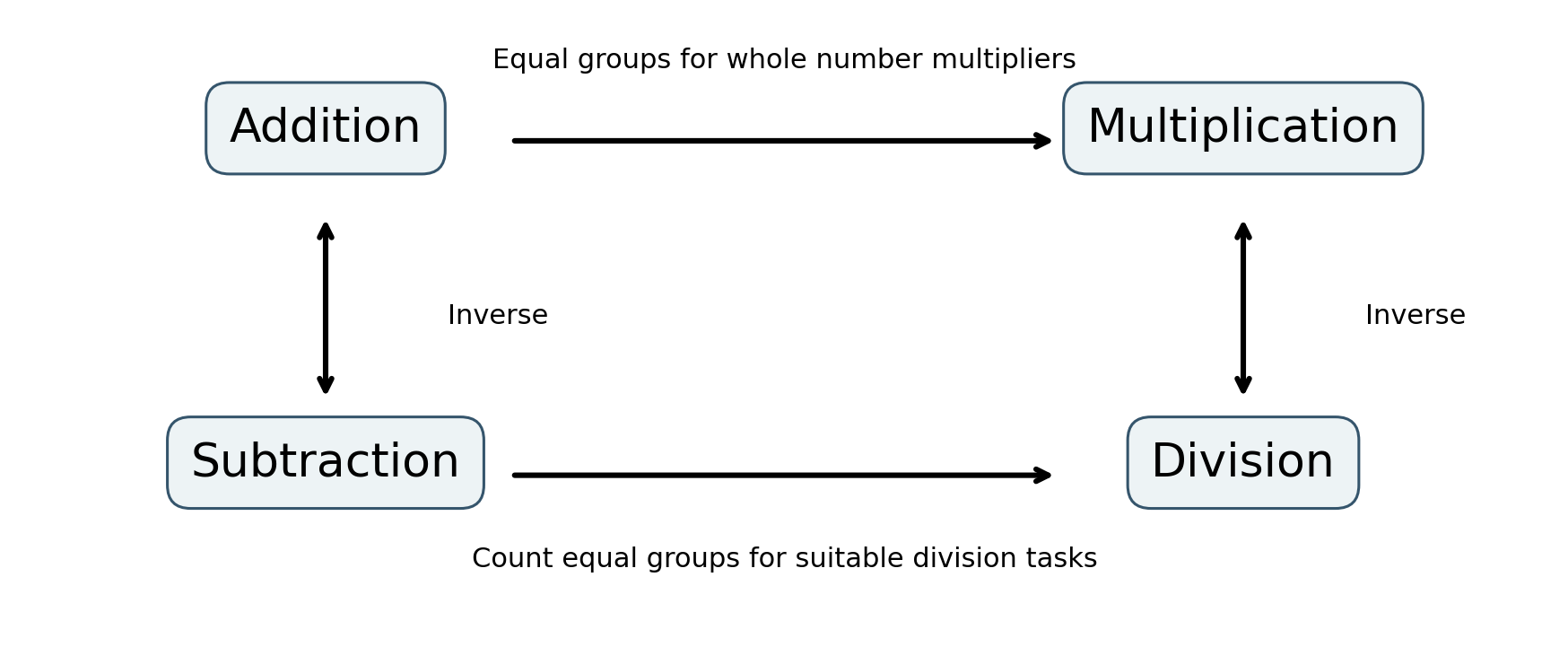
A checking cue
An inverse operation can undo the change. What happens when you subtract one addend from the total?
Read the explanation
12 − 5 = 7 and 12 − 7 = 5 check the addition. Likewise, 15 ÷ 3 = 5 and 15 ÷ 5 = 3 check 5 × 3 = 15. Multiplication and division are inverse operations when the divisor is not zero.
Try it
Which calculation checks 8 × 4 = 32?
Choose an answer when you are ready.
Equal groups are a beginning
Repeated addition illustrates multiplication by a nonnegative whole number. Multiplication by a fraction also involves scaling: half of eight is four.
Division includes equal sharing and counting groups. Repeated subtraction can illustrate counting groups, but does not explain every kind of division.
Reflect
Can you show 12 ÷ 3 as sharing and as counting groups? What changes in your explanation?
An essential boundary
Division by zero is undefined in ordinary arithmetic. Zero divided by a nonzero number is zero.