
Japanese soroban
A comparison of representations and teaching possibilities—not a ranking. Practical merits and limitations below are our design analysis.
How it works
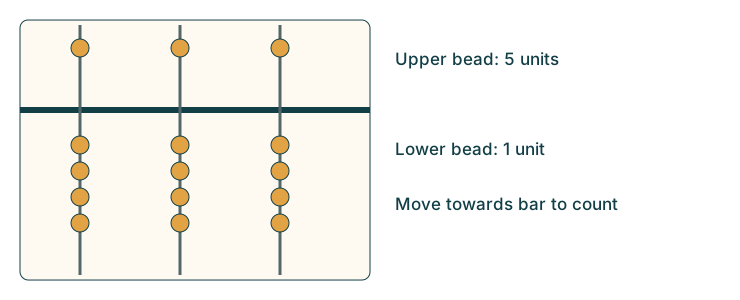
The modern soroban has one upper five-unit counter and four lower one-unit counters per rod. Beads brought towards the reckoning bar are active. A rod’s assigned place determines their scaled value.
Soroban: 5 + 3 = 8
TUA: 8 × 1 = 8
Practical merits
Five-plus-units encoding is compact. Established procedures support arithmetic and mental-abacus practice.
Limitations and teaching needs
The learner must distinguish bead roles and learn five/ten complements. Assigning unit position and decimal places requires conventions. Compactness does not itself establish easier learning.
What the evidence establishes
A three-year randomized study of 204 children reported arithmetic advantages for mental-abacus instruction but no change in basic cognitive capacities. The result concerns a particular training programme, not every soroban user or a general intelligence increase.
How this relates to The Ultimate Abacus
TUA uses nine equal-value beads per decimal position and zero as an empty count. Its fifth bead is a visual cue, not a bead worth five. Both approaches can use complement identities; TUA has no equivalent outcome study.
How does 8 appear as 5 + 3 on a soroban and as eight active beads on TUA?
Sources
Reviewed 6 October 2026. Provider descriptions are not independent endorsements.
All comparisons