
Russian schoty / tchoty
A comparison of representations and teaching possibilities—not a ranking. Practical merits and limitations below are our design analysis.
How it works
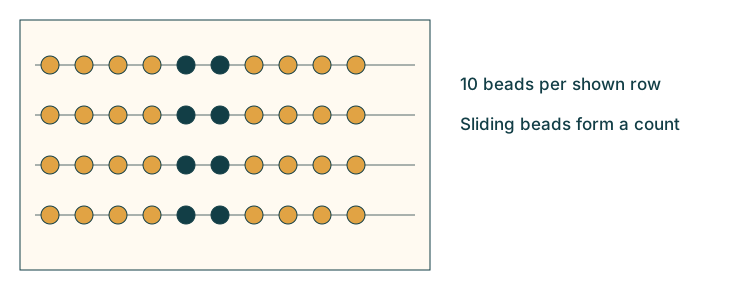
The Smithsonian specimen has seven ten-bead rods and one four-bead rod. The ten-bead rods distinguish the central pair by colour. Russian abacus variants should not be assumed identical.
Digit values: 0, 1, …, 9
Ten units exchange for one ten
Practical merits
Equal-value beads on a rod allow direct counting. Colour grouping supplies an additional visual reference.
Limitations and teaching needs
A ten-counter row needs conventions for carrying and reading. Special rows in historic instruments may serve particular fractions or accounting conventions; their purpose must be checked for the model.
What the evidence establishes
The collection record supports the specimen’s construction, not a measured learning advantage. No schoty-specific classroom outcome is established by this article.
How this relates to The Ultimate Abacus
TUA also counts equal-value beads, but its decimal digit position uses nine beads plus an empty zero. It explicitly labels whole/fractional places and separates positive/negative areas. These are differences in representation, not evidence of superiority.
What changes when a row has ten counters rather than nine?
Sources
Reviewed 6 October 2026. Provider descriptions are not independent endorsements.
All comparisons