
Montessori golden beads and bead frames
A comparison of representations and teaching possibilities—not a ranking. Practical merits and limitations below are our design analysis.
How it works
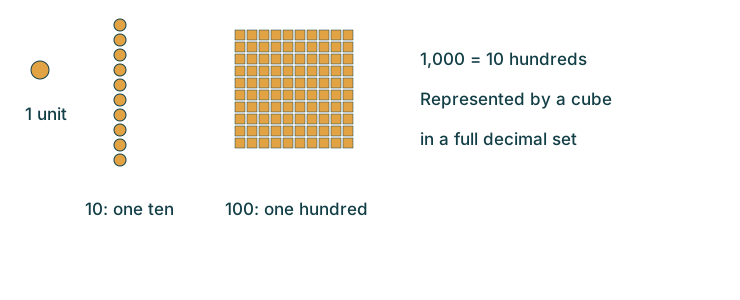
A unit bead, a ten-bar, a hundred-square and a thousand-cube show decimal groups physically. The wider Montessori mathematics sequence also uses bead frames and other materials; it is not one abacus product.
10 units = 1 ten
10 tens = 1 hundred
Practical merits
Golden beads make exchange quantities visible in actual groups. Moving and comparing pieces offers a concrete discussion of ten units, ten tens and ten hundreds.
Limitations and teaching needs
Loose materials require space and organisation. Golden beads and bead frames are different representations; a learner needs help connecting them to written notation. This is a design consideration, not a measured disadvantage.
What the evidence establishes
A lottery-admission study followed 141 preschool children and reported advantages on several outcomes for the Montessori programme. It did not isolate golden beads, bead frames or their effect on arithmetic. Whole-programme evidence must not be presented as proof for one material.
How this relates to The Ultimate Abacus
TUA records groups through rod position and active bead count. It does not physically contain one hundred unit beads inside a hundreds bead. Its size differences are cues, not Montessori-style proportional quantity construction.
How is exchanging ten actual unit beads different from exchanging a count between labelled rods?
Sources
Reviewed 6 October 2026. Provider descriptions are not independent endorsements.
All comparisons