
Number lines and ten-frames
A comparison of representations and teaching possibilities—not a ranking. Practical merits and limitations below are our design analysis.
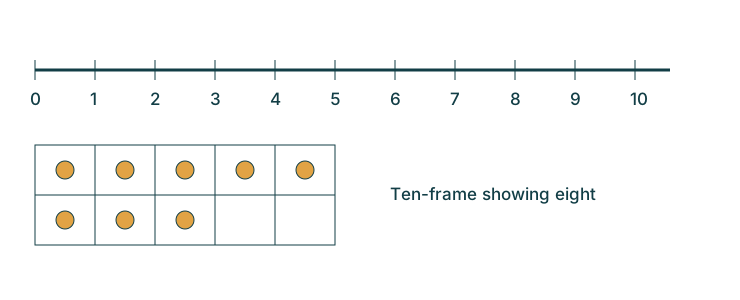
How it works
The Math Learning Center offers lines with whole, fractional, decimal or negative labels and jumps. Number Frames places counters into five-, ten- and other frames.
10 = 7 + 3
−3 < 0 < 3
Practical merits
Number lines express order and distance; ten-frames organise small counts and complements. They can complement bead representations.
Limitations and teaching needs
Line scale, tick spacing and reference values must be clear. Ten-frame locations do not automatically represent tens, hundreds or decimal places.
What the evidence establishes
These provider pages document features and intended uses. They do not establish a product-specific causal learning advantage.
How this relates to The Ultimate Abacus
TUA’s rods encode place, not spatial distance along a number line. Its four regions are not coordinate quadrants. A line can separately explain crossing zero; a ten-frame can discuss complements.
How could a line and a bead frame show the same −3 in different ways?
Sources
Reviewed 6 October 2026. Provider descriptions are not independent endorsements.
All comparisons