
School counting frames
A comparison of representations and teaching possibilities—not a ranking. Practical merits and limitations below are our design analysis.
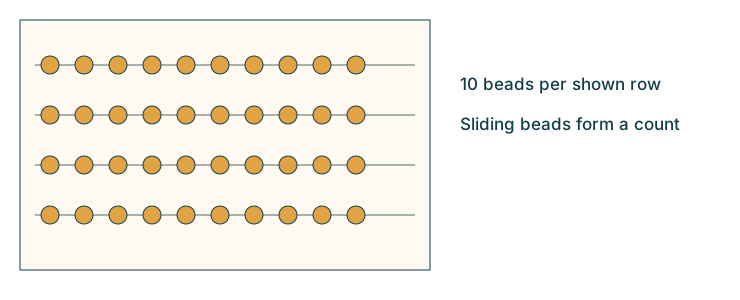
How it works
Teaching numeral frames developed as classroom arithmetic apparatus; the Smithsonian documents their use for operations and some place-value instruction. Layouts and row meanings vary.
Count + agreed meaning of each counter = represented value
Practical merits
A large frame can support shared demonstrations, counting, grouping and discussion.
Limitations and teaching needs
A row may simply be another group of objects, rather than a tens or hundreds place. Without an explicit convention, learners can mistake a counting frame for a positional abacus.
What the evidence establishes
Historical use is documented. Longevity, popularity and visible construction do not prove an educational effect for every model.
How this relates to The Ultimate Abacus
TUA specifies a place value for each rod. Counting ten beads on an ordinary classroom row is not automatically equivalent to activating one bead on a labelled tens rod.
What does one row mean: another group, or a larger place?
Sources
Reviewed 6 October 2026. Provider descriptions are not independent endorsements.
All comparisons